ISO 14001 step-by-step guide
The ISO 14001 step-by-step guide takes you from zero to certificate in 11 steps: from orientation and gap analysis to the certification audit. You certify against the standard published by ISO , through an accredited body . Below, we walk through each step, with realistic timeframes and the points where companies often get stuck.
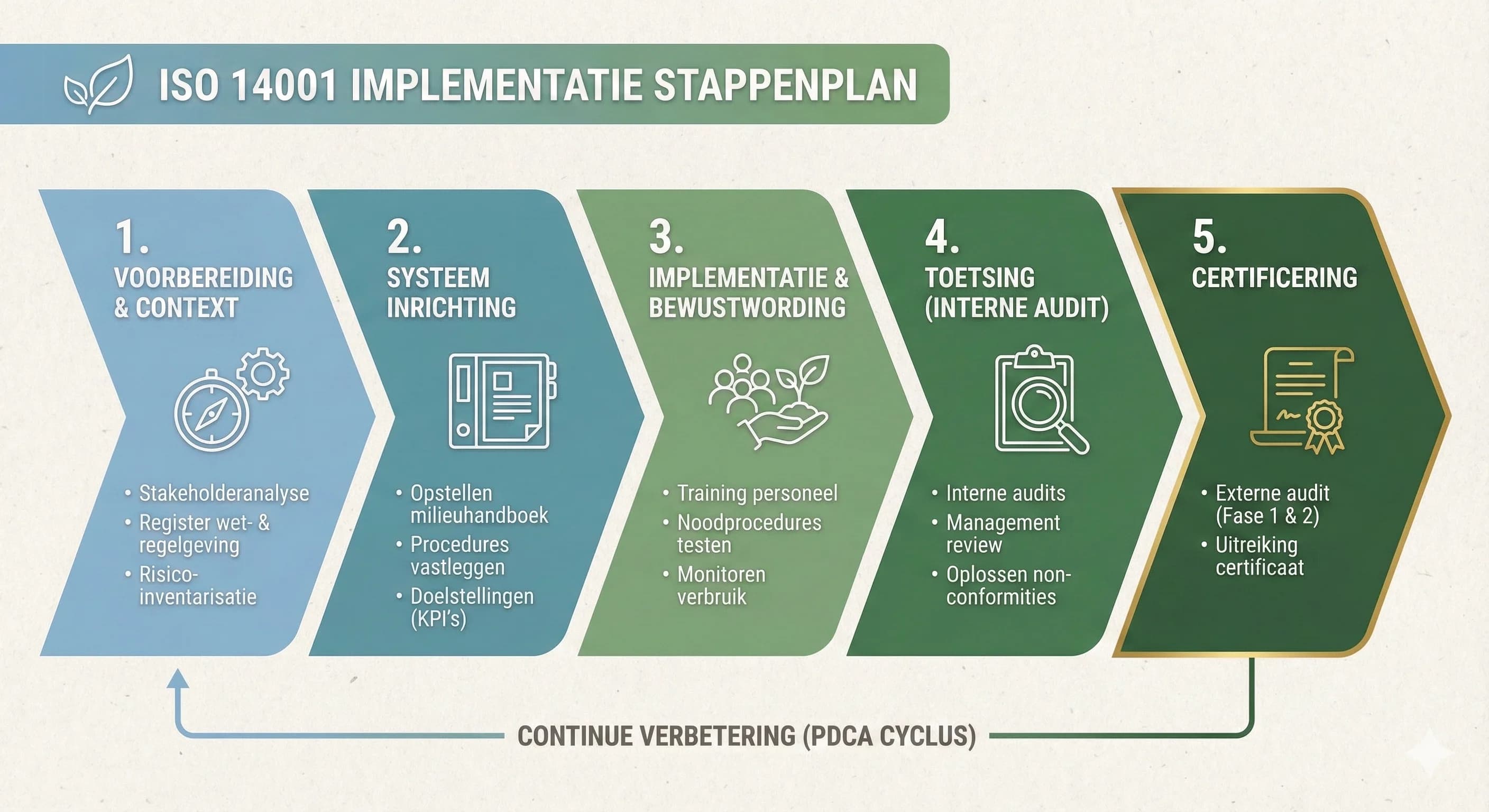
The timeframe depends on your company size and starting position. A small company with clear processes can be ready in 3-4 months. A larger organisation with complex environmental aspects needs 6-9 months.
The 11 steps to ISO 14001 certification
The route from zero to certificate consists of 11 steps. The table below gives you an overview, from orientation to maintaining your certificate. Below it, we work out each step.
| Step | What do you do? |
|---|---|
| 1. Orientation and support | Make the decision, involve management, appoint a project lead |
| 2. Gap analysis | Map out what you already have and what is missing |
| 3. Identify environmental aspects | Determine which activities affect the environment |
| 4. Set environmental objectives | Set concrete, measurable objectives for each environmental aspect |
| 5. Set up documentation | Record policies, procedures and records |
| 6. Implement and apply | Train staff, keep records, let the system run |
| 7. Internal audit | Check your own system for compliance with the standard |
| 8. Management review | Management reviews the environmental management system |
| 9. Choose a certification body | Request quotes from accredited bodies |
| 10. Certification audit | External audit in two stages (documentation + practice) |
| 11. Certificate and maintenance | Receive the certificate, annual surveillance audits |
Below, we work out each step.
Tip: Step 3 (identifying environmental aspects) is the foundation of your whole system. If you get it right, the objectives and measures fall logically into place. So spend most of your time on it.
Orientation and support
Before you start, the decision needs careful thought. Why do you want this certificate? Is it because customers ask for it, because you want to reduce your environmental impact, or both? The reason partly determines how you approach the process.
Management must back it. Not just on paper, but actively. ISO 14001 requires top management to be involved in the environmental policy and objectives. Without commitment from the top, it becomes a difficult process that will probably stall.
Also appoint someone to lead the project. This does not have to be a full-time role, but someone must be responsible for progress.
Carry out the gap analysis
A gap analysis maps out what you already have and what is still missing. You go through the requirements of ISO 14001 and honestly assess where you stand. Do you already comply? Partly? Not at all?
Most companies have more in place than they think. You are probably already complying with environmental rules, you have procedures for waste management, and you know which permits you need. The art is to make this explicit and find the gaps.
The result is a list of action points. This becomes your roadmap for implementation.
Identify environmental aspects
This is a core step in ISO 14001. You map out which activities, products and services of your organisation affect the environment. These are called environmental aspects.
Examples of environmental aspects are energy use, water use, emissions to air, discharges to water, waste production, use of raw materials, and transport. But indirect aspects also count, such as the environmental impact of your suppliers or the energy use of your products at the customer’s site.
Next, you determine which aspects are significant. Not everything is equally important. You assess the aspects against criteria such as the scale of the impact, how often it occurs, legal requirements, and the ability to control it.
A printing company may conclude that ink use, paper waste and energy use are the significant aspects. A transport company focuses on fuel use and emissions. An IT company looks at the electricity use of servers and the lifespan of hardware.
Set environmental objectives
For the significant environmental aspects, you set concrete objectives. These objectives must be measurable and have a timeframe, so you can check whether you achieve them.
Examples of environmental objectives are reducing energy use by ten per cent within two years, cutting residual waste by fifteen per cent per year, or switching to 100% green electricity by the end of the year.
Each objective comes with an action plan. What will you do to reach the objective? Who is responsible? What resources are needed?
Set up documentation
You record your environmental management system in documentation. This does not have to be a thick handbook, but you must be able to show how your system works.
The documentation typically covers the environmental policy, the scope of your system, the environmental aspects and their assessment, the objectives and action plans, procedures for critical activities, and records that prove you do what you say.
You can choose the format yourself. Some companies work with text documents, others with flowcharts or digital systems. As long as it is accessible and up to date, it is fine.
A common mistake is over-documenting. Keep it practical. If nobody reads your procedures, they are no use. A simple instruction that people follow is worth more than a detailed procedure that ends up in a drawer.
Implement and apply
Documentation alone is not enough. You must show that the system works in practice. This means you train staff, keep records, and run the system for a while before the auditor arrives.
Train staff in their role within the environmental management system. What is expected of them? What should they watch out for? How do they report deviations?
Keep records of your environmental performance. Energy use per month, amount of waste, results of measurements. You need this data to assess whether you meet your objectives, and the auditor will want to see it.
Internal audit
Before the external auditor visits, you check yourself whether your system complies. This is the internal audit, and it is a mandatory part of the standard.
During the internal audit, you go through all the requirements of ISO 14001 and check whether you meet them. You speak to staff, review records, and assess whether reality matches what you have documented.
The person carrying out the audit must not check their own work. The environmental coordinator therefore cannot audit their own procedures. In smaller companies, this is often done by someone from outside.
The result of the internal audit is a report with findings. You must resolve nonconformities before the certification audit takes place. Read the full approach and a checklist per clause on the ISO 14001 internal audit page.
Management review
Management periodically reviews the environmental management system. This is a formal requirement of the standard and an important checkpoint.
In the management review, you discuss the results of audits and inspections, the extent to which objectives have been achieved, complaints and incidents, changes in laws and regulations, and opportunities for improvement.
The output is a list of decisions, with any changes to policy, objectives or resources. Keep the minutes, because the auditor will ask for them.
Choose a certification body
You choose an accredited certification body for the audit. In the Netherlands, options include Kiwa , TÜV , DNV , Bureau Veritas , DEKRA , and LRQA .
Choose a body accredited by the Dutch Accreditation Council (RvA) . Only then is your certificate officially recognised. You can check this in the register on the RvA website.
Request quotes from two or three bodies. Compare not only on price, but also on lead time and the auditor’s experience in your sector.
Certification audit
The certification audit consists of two stages, which usually take place shortly after each other but can sometimes be combined.
In stage 1, the auditor reviews your documentation and determines whether you are ready for stage 2. This can take place on site or remotely. You receive feedback on any shortcomings that you must resolve.
In stage 2, the auditor visits your site. They check whether your system works as described. They speak to staff, review records, walk around the workplace, and follow processes. This is the real test.
Afterwards, you receive a report. If there are nonconformities, you have the chance to resolve them before the certificate is issued. For serious nonconformities, a re-audit may be needed.
Certificate and maintenance
If the audit is positive and any nonconformities have been resolved, you receive the ISO 14001 certificate. It is valid for three years.
But the work does not stop there. Every year, the auditor returns for a surveillance audit to check that you maintain and improve the system. After three years, a recertification audit follows for a new certificate.
ISO 14001 timeframes by company size
Small (1-25)
Timeframe: 3-5 months
- Orientation and gap analysis: 1-2 weeks
- Environmental aspects and objectives: 2-3 weeks
- Documentation: 3-4 weeks
- Implementation: 4-6 weeks
- Internal audit and management review: 1 week
- Certification audit: 1-2 days
Getting ISO 14001 if you already have ISO 9001
Do you already have an ISO 9001 certificate? Then you have a head start. Both standards follow the same structure, the High Level Structure. Many elements can be reused.
You already have a context and stakeholder analysis, a policy statement, an audit process, a management review, and document control. You only need to extend these with the environmental elements.
The process is then shorter, typically two to four months shorter than starting from zero. And you can combine the audits, which saves costs.
Read more about combining ISO 9001 and ISO 14001.
Tips for a smooth ISO 14001 process
Start with reality. Describe how you work now first, and only then where you want to go. A system that fits your practice works better than an ideal picture that nobody follows.
Involve the shop floor. Environmental management is not an office project. Talk to the people who do the work. They know where the environmental impact is and which improvements are feasible.
Set realistic objectives. Ambitious objectives are good, but they must be achievable. An objective you do not reach demotivates. A modest objective that you exceed is better.
Plan time for implementation. You need evidence that the system works. The auditor wants to see records covering several months. Start early enough.
Common mistakes in ISO 14001 implementation
| Mistake | Consequence |
|---|---|
| Starting too late | Stress, rushed work, a system that does not hold together |
| No management commitment | Certification becomes a paper tiger |
| Copying environmental aspects from others | Does not fit your own situation, the auditor sees through it |
| Unrealistic objectives | Objectives are not met, frustration |
| Focusing only on documentation | The system does not live, staff know nothing about it |
Next step towards ISO 14001
Want to know what the process costs? Read on at costs and timeline. Or look at the specific requirements of the standard.