VCA step-by-step plan
The route to VCA certification is clearer than for many other certifications. The SSVV (Stichting Samenwerken Voor Veiligheid, the foundation that manages VCA) manages the scheme and the VCA register . VCA is practical in nature: the requirements are concrete, the checklist is clear, and the process is predictable. Even so, good preparation is essential. An audit without preparation almost certainly leads to non-conformities and delay.
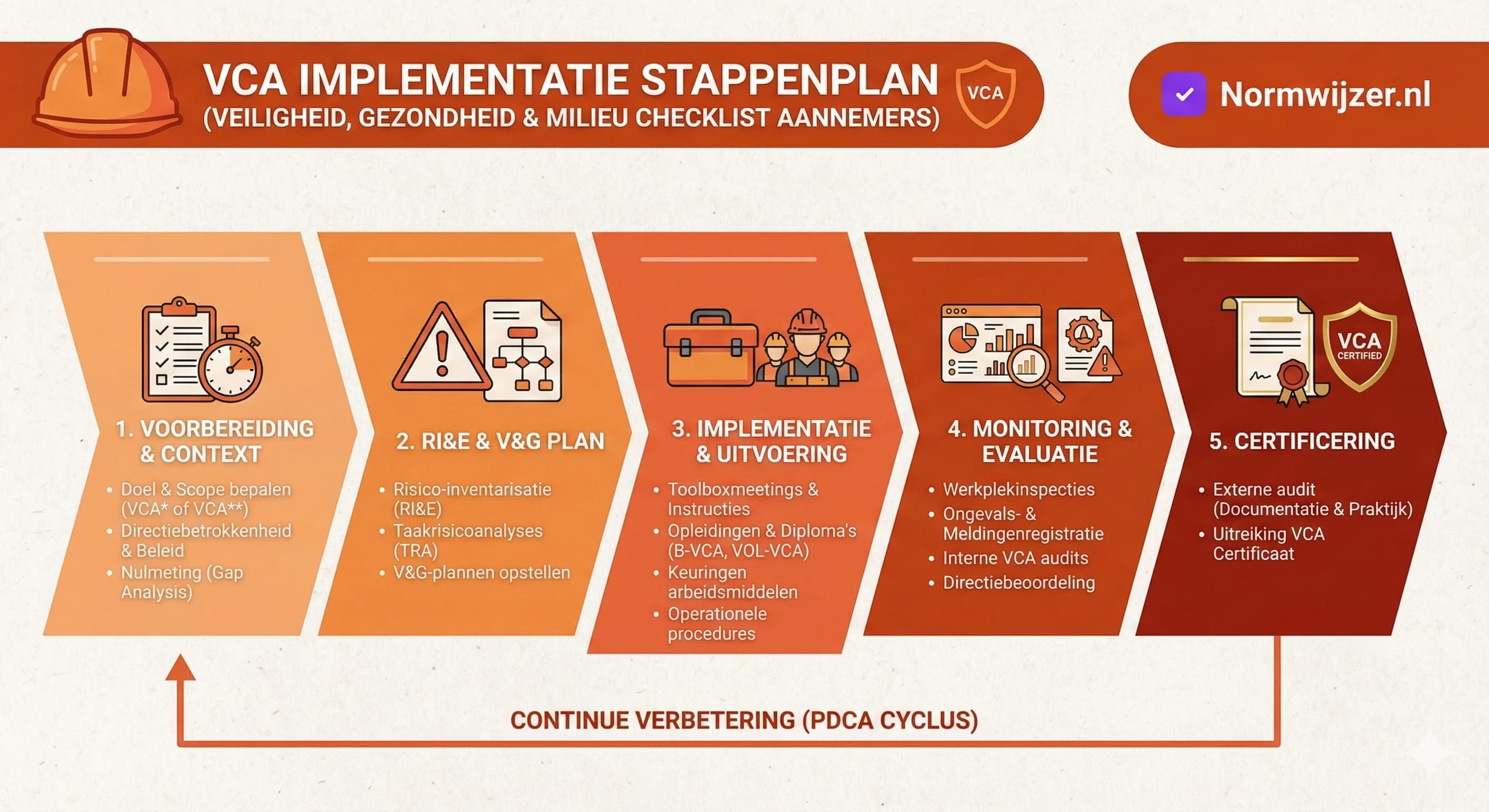
This step-by-step plan takes you through the whole process, from the first orientation to the moment you have the certificate in hand. The lead time depends on your starting position and the level you aim for. For an average SME, plan for two to four months for VCA* and three to six months for VCA**.
This step-by-step plan assumes a company that does not yet have VCA. If you are already certified and want to upgrade from VCA* to VCA**, or if you are preparing for recertification, some steps are simpler because you already have a foundation.
The 10 steps to VCA certification
The process from zero to certificate consists of 10 steps. The table below gives you an overview, from choosing the level to receiving your certificate. We explain each step below.
| Step | What do you do? |
|---|---|
| 1. Determine the level | Choose between VCA*, VCA** or VCA Petrochemie |
| 2. Inventory the current situation | Check diplomas, registrations and procedures |
| 3. Arrange safety diplomas | Plan and pass the B-VCA and VOL-VCA exams |
| 4. Set up documentation | Set up policies, procedures and registration forms |
| 5. Implement in practice | Carry out toolbox meetings, incident reports and inspections |
| 6. Choose a certification body | Request quotes from accredited bodies |
| 7. Internal check | Go through the VCA checklist yourself and resolve non-conformities |
| 8. The audit | External audit: document and practice check |
| 9. Resolve non-conformities | Carry out corrective measures within 90 days |
| 10. Receive certificate | Registration in the VCA register |
We work out each step below.
Tip: Start early with step 3 (safety diplomas). Waiting times for B-VCA and VOL-VCA exams can build up, and you cannot be certified without valid diplomas. That is a hard requirement.
Step 1: Determine the right level
The first question to answer is which VCA level you need. This determines not only the requirements you must meet, but also the costs and lead time of the process.
Start by looking at what your clients ask for. If your clients explicitly require VCA**, there is no point aiming for VCA*. Ask your most important clients which level they expect. Many large industrial companies and main contractors set VCA** as the standard requirement.
Also consider your role in projects. If you direct other subcontractors or have coordinating tasks, VCA** is usually necessary. VCA* is primarily intended for companies that carry out executional work under the direction of others.
Do you work in the petrochemical industry? Then VCA Petrochemie is often the requirement. Refineries and chemical plants generally do not accept contractors with only VCA* or VCA**. Check the specific requirements of the locations where you work.
The page on VCA levels gives a detailed comparison of the three levels.
Result: A decision on the level to aim for (VCA*, VCA** or VCA Petrochemie).
Step 2: Inventory your current situation
Before you start, it is sensible to take stock of what you already have. Many companies turn out to do more on safety than they think, just not always documented or structured.
Start with the safety diplomas of your employees. Who holds B-VCA? Who holds VOL-VCA? Are these diplomas still valid? VCA diplomas are valid for ten years, so check the expiry date. Make an overview of all employees with their diplomas and expiry dates.
Then look at your current safety practice. Do you hold toolbox meetings? If so, are they recorded? Are incidents and near misses reported and recorded? Is there a procedure for the use of personal protective equipment? Are workplace inspections carried out?
For VCA** you also look at the management level. Is there a written safety policy? Are risk inventories carried out? Is management demonstrably involved in safety? Are safety objectives set and monitored?
It can help to take the VCA checklist and assess point by point where you stand. This gives you a concrete picture of the actions still to be taken.
Result: An inventory of your current situation and an overview of the gaps against the VCA requirements.
Step 3: Arrange the safety diplomas
The safety diplomas of employees are a hard requirement for VCA. Without the right diplomas, you cannot be certified. So start early in getting these in order.
For VCA*, all operational employees who carry out high-risk work must hold a valid B-VCA diploma. Operational managers, such as foremen and work planners, need VOL-VCA. The Stichting Samenwerken Voor Veiligheid (SSVV, the foundation that manages VCA) manages the diploma register and the exam requirements.
For VCA**, the same requirements apply, but the definition of “operational manager” can be broader. Staff members involved in safety matters, such as the preventive safety officer or the KAM coordinator, often also need VOL-VCA.
Schedule the exams well in advance. Exams are administered by accredited examination institutes such as PBNA , Dirksen and SHE Academy . Waiting times can build up, especially in busy periods.
Prepare employees for the exam. This can be done through a classroom course, e-learning or self-study. The official course material is available through the SSVV. Most employees who prepare pass the exam; the pass rate is around 80-90%.
Result: All employees hold the required valid safety diplomas.
Step 4: Set up the documentation
VCA requires certain documentation. The scope depends on the level: VCA* requires less documentation than VCA**, and VCA Petrochemie requires the most.
For VCA* you need at least:
- An overview of employees with their safety diplomas
- Records of toolbox meetings
- Records of incidents and near misses
- Instructions for the use of personal protective equipment (PBM)
- Records of workplace inspections
For VCA** a management layer is added:
- A safety policy signed by management
- Risk inventories and evaluations for your work
- A VGM plan (Safety, Health and Environment, VGM)
- Objectives and measurable indicators for safety
- Records of management involvement in safety
- Procedures for the purchasing and selection of subcontractors
The documentation does not need to be extensive. VCA values practical, workable documents over thick manuals that nobody reads. A toolbox record can be a simple form with the date, subject, attendees and signatures. A safety policy does not need to be ten pages; one page with the key points is enough.
Use templates where possible. The SSVV and many certification bodies offer sample documents. Adapt these to your own situation rather than building everything from scratch.
Result: Complete documentation that meets the VCA requirements for the chosen level.
Step 5: Implement in practice
Documentation alone is not enough. VCA requires evidence that safety is actually alive in the organisation. The auditor wants to see that procedures are followed and that records are kept.
Start with toolbox meetings if you do not yet hold them. A toolbox is a short discussion, usually 15-30 minutes, in which a safety topic is discussed. This can take place in the office, but also at the work location. Discuss current risks, incidents from the news, or specific hazards of the work being carried out. Record each toolbox with the date, subject and attendees.
Make sure incidents and near misses are reported and recorded. For many companies this is a change of culture. Make it clear that reporting is not punished but is an opportunity to learn. Analyse incidents and take measures to prevent recurrence.
Carry out workplace inspections. This can be a formal inspection with a checklist, but also a quick round by a manager who looks for unsafe situations. Record the findings and address any problems identified.
For VCA**, the management processes must also be in operation. Hold a management review in which safety is discussed. Set objectives and monitor progress. Carry out risk inventories for new projects or changed work.
A common mistake is going to the audit too quickly. Make sure your processes have been running for at least two to three months before you schedule the audit. The auditor wants to see records over a longer period, not just from the last week.
Result: Working processes with records built up over a representative period.
Step 6: Choose a certification body
VCA certification is carried out by accredited certification bodies. Not every certifier may carry out VCA audits; they must be accepted by the SSVV . The SSVV publishes a list of recognised certification bodies on its website.
Known certification bodies for VCA in the Netherlands include Kiwa , TÜV , DNV , Bureau Veritas and LRQA . Request quotes from several bodies and do not compare on price alone.
When making your choice, consider:
- The body’s experience in your sector
- Availability and scheduling (some bodies have long waiting times)
- The costs of the initial audit and the annual interim audits
- Communication and customer service
- Whether the body also offers other certifications you may want to obtain later
If you already hold ISO 9001 or another ISO certification, it can be efficient to have VCA handled by the same body. Some bodies offer discounts for combined audits.
Result: A chosen certification body and a scheduled audit date.
Step 7: Carry out an internal check
Before the external auditor arrives, it is sensible to check yourself that everything is in order. An internal check, or gap audit, prevents surprises during the real audit.
Go through the VCA checklist point by point. Is all documentation complete and up to date? Are all diplomas valid and registered? Are there enough records of toolboxes, incidents and inspections? Are the records from the last few months complete?
Talk to employees. Do they know what the safety policy contains? Do they know how to report an incident? Do they know where to find the procedures? The auditor will also speak to employees, so make sure they are prepared.
Visit a work location with a critical eye. Is work being carried out according to the procedures? Is the correct PPE being worn? Are the materials and tools in good condition? Is the work set up safely?
Document your findings and address any non-conformities before the audit takes place. It is better to discover and resolve a problem yourself than to have the auditor find it.
Result: A checked system with non-conformities resolved.
Step 8: The audit
The VCA audit consists of two parts: a document check and a practice check. Depending on the certification body and the size of your company, this may take place in one day or spread over several moments.
In the document check, the auditor assesses your documentation and records. Are the diplomas in order? Are the procedures complete? Are there enough records of toolboxes, incidents and inspections? Does the safety policy meet the requirements?
In the practice check, the auditor visits one or more work locations. The auditor observes the work, speaks to employees, and checks whether practice matches the documentation. Are the procedures being followed? Is the correct PPE being worn? Do employees know what to do in the event of an incident?
The auditor may ask questions to randomly selected employees. Prepare your employees for this, but do not instruct them to give “the right answer”. Auditors recognise rehearsed answers. Honesty and genuine knowledge work better.
At the end of the audit, the auditor discusses the findings. These may be conformities (you comply), observations (improvement points that are not a non-conformity), or non-conformities (you do not meet a requirement).
Result: An audit report with findings.
Step 9: Resolve non-conformities
If the audit is positive with at most minor non-conformities, you receive the certificate, provided you resolve the non-conformities within the set deadline. The deadline is usually 90 days.
For each non-conformity, you must analyse what went wrong and take a corrective measure. It is not enough to fix the symptom; you must address the cause. For example, if the non-conformity is that an employee does not hold a valid diploma, the measure is not only that the employee takes the exam, but also that your checking process is improved so that this can no longer happen.
Document the corrective measures and the evidence that they have been carried out. Send this to the certification body. The body assesses whether the measures are adequate and then releases the certificate.
For major non-conformities, a follow-up audit may be needed before the certificate is issued. This means extra costs and delay, but it is not a disaster. Resolve the non-conformity thoroughly and schedule the follow-up audit.
Result: Resolved non-conformities and a released certificate.
Step 10: Receive your certificate
After a successful audit and the resolution of any non-conformities, you receive the VCA certificate. The certificate is valid for three years and is registered in the VCA register , where clients can check whether you are certified.
With the certificate, you can show clients that you meet the VCA requirements. Many companies state their VCA status on their website, in quotes and on company vehicles.
The certificate is the beginning, not the end. Over the next three years you must maintain the system and undergo an annual interim audit. At the end of the three years, a recertification audit follows.
Result: A valid VCA certificate registered in the VCA register.
After certification
Obtaining the certificate is a milestone, but the work does not stop there. VCA requires ongoing attention to safety.
Each year the certification body returns for an interim audit. This audit is shorter than the initial audit and checks whether you still meet the requirements. The auditor reviews a selection of the requirements and checks whether non-conformities from earlier audits have been resolved.
Keep your records up to date. Toolboxes, incidents and inspections: if these records lapse after the audit, you will have problems at the next check. Make it a routine, not something you only do around audit time.
Keep an eye on the diplomas. With a validity of ten years, it is easy to forget expiry dates. Keep an overview and plan renewal exams for employees whose diplomas are about to expire in good time.
Keep improving. VCA is not the finish line but a minimum standard. Use incident analyses, inspection reports and employee feedback to continuously improve your safety.
Common mistakes in implementing VCA
Starting diplomas too late. Exams have waiting times and employees need to prepare. Plan the diplomas first and do not wait until the last moment.
Too few records. The auditor wants evidence over a longer period. If you start toolbox records three months before the audit, you have too little history. Start early and build up records.
Paper tiger. Documents that nobody knows or follows do not help. Make sure procedures are practical and that employees know what is in them.
Underestimating the audit. VCA is more practical than many ISO standards, but it is not a formality. The auditor checks seriously and will record non-conformities if matters are not in order.
More information
- Costs and timeline - What does VCA certification cost?
- Requirements - The VCA checklist explained
- Levels - VCA*, VCA** or Petrochemie?
- Audit - The audit process explained