ISO 45001 step by step
The route to ISO 45001 certification requires a structured approach. You can get the standard from NEN , and certification takes place through an accredited body . This step-by-step plan guides you through the process, from your first orientation to the moment you hold the certificate.
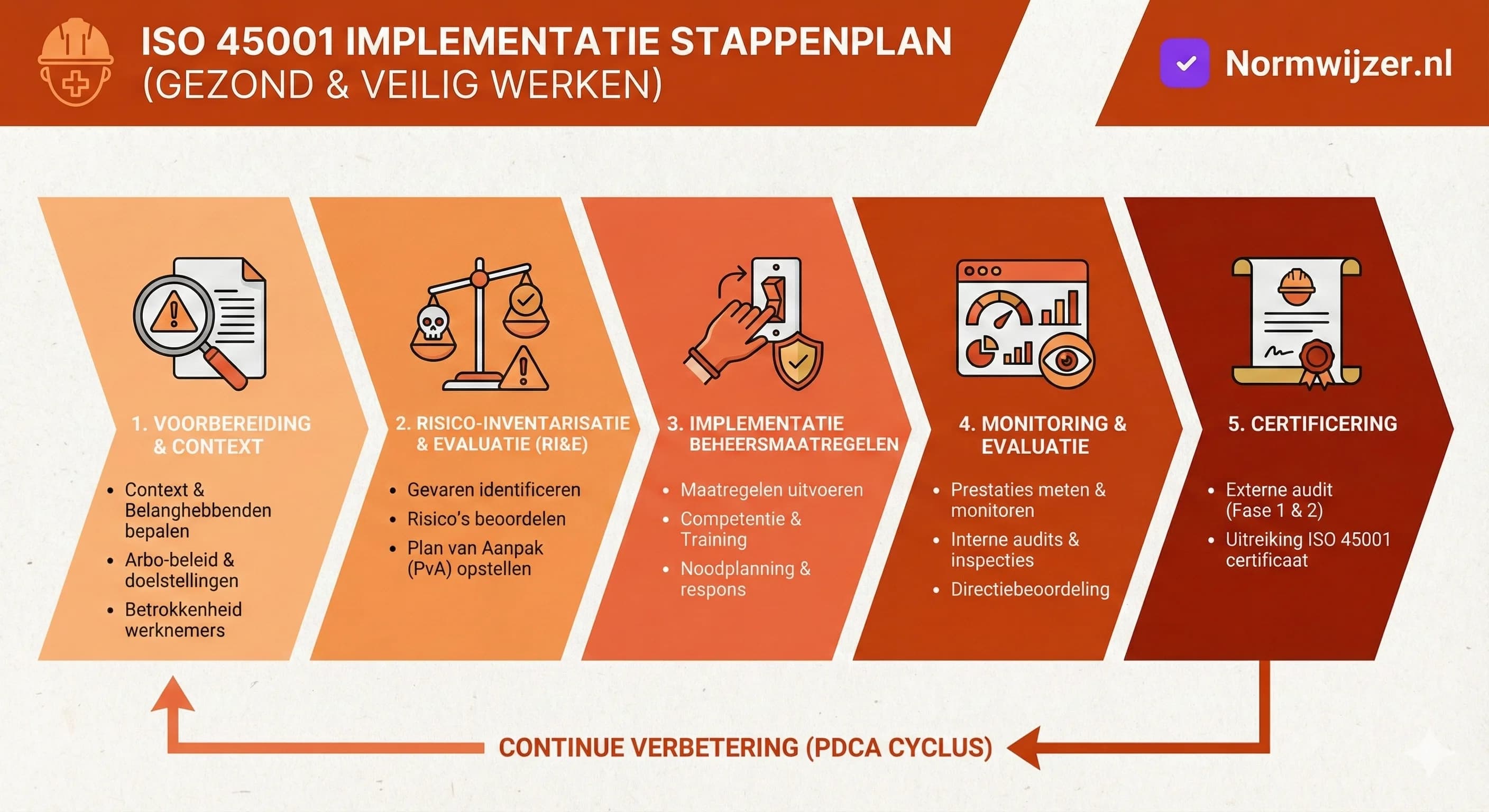
Overview of the ISO 45001 route
The certification route has three main phases: preparation, implementation and certification. The total timeframe depends on your starting position and the capacity you have available.
Small business
1-25 employees
Timeframe: 4-6 months
For a small business with clear processes and limited risks, the route can be completed relatively quickly. The challenge is often finding enough time alongside day-to-day work.
The 10 steps to ISO 45001 certification
The route from zero to certificate consists of 10 steps. The table below gives an overview, from orientation to the certification audit. We explain each step below it.
| Step | What do you do? |
|---|---|
| 1. Orientation and decision | Make a business case, involve the management, appoint a project leader |
| 2. Gap analysis | Compare the current situation with the standard |
| 3. Identify hazards and assess risks | Systematically map hazards and risks |
| 4. Policy and objectives | Formulate the Arbo policy with measurable goals |
| 5. Processes and procedures | Set up operational controls and support |
| 6. Implement and apply | Train employees, build up records |
| 7. Internal audit | Check your own system for compliance |
| 8. Management review | Management formally evaluates the system |
| 9. Choose a certification body | Request quotes from accredited bodies |
| 10. Certification audit | External audit in two stages (documentation and practice) |
We explain each step below.
Tip: ISO 45001 places more emphasis on worker participation than other ISO standards. Involve employees actively from step 3 (hazards and risks). They know the risks on the shop floor best, and the auditor will ask them about these.
Orientation and decision
Before you start, it should be clear why you want ISO 45001 and whether it is the right choice for your organisation. This is the moment to make the business case.
Ask yourself whether clients or principals are asking for it, whether you already have VCA and whether that is enough, what the expected costs and benefits are, and whether there is enough internal support.
Involve the management in this decision. Without commitment from the top, the route will be difficult. The standard explicitly requires management involvement.
If you decide to go ahead, appoint a project leader. This is someone who gets time to drive the route, preferably with an affinity for safety and quality management.
Carry out the gap analysis
The gap analysis shows where you stand against the standard. What have you already arranged? Where are the gaps? This gives direction for the rest of the route.
During the gap analysis, you assess each clause of the standard. For clause 4, you check whether you know which internal and external factors affect occupational safety. For clause 5, you ask whether management is actively involved in safety policy. For clause 6, you examine whether there is a systematic hazard inventory. You go through all the requirements in this way.
The outcome is an overview of what needs to happen, prioritised by urgency and impact. This forms the basis for your implementation plan.
If you already have ISO 9001 or ISO 14001, part of your system is already in place. The HLS structure means that elements such as document control, internal audits and management review can be reused.
Identify hazards and assess risks
This is the heart of ISO 45001. You systematically map which hazards are present in your organisation and assess the related risks.
Hazards are sources that could potentially lead to injury or illness. Think of machines with moving parts, work at height, exposure to hazardous substances, ergonomic strain, but also psychosocial risks such as work pressure and aggression.
For each hazard, you determine the risk by looking at the likelihood that something will go wrong and the severity of the possible consequences. This gives a priority order: which risks do you tackle first?
This process resembles the legally required RI&E (risk inventory and evaluation), but goes further. ISO 45001 also asks you to identify opportunities: possibilities to improve occupational safety.
Formulate policy and objectives
Based on the identified risks, you formulate policy and objectives. The policy describes the organisation’s intentions regarding health and safety. The objectives make this concrete and measurable.
Good Arbo policy includes a commitment to preventing injury and illness, a commitment to complying with laws and regulations, and a commitment to continual improvement. It is signed by the management and communicated to all employees.
Objectives are specific and measurable. Not “we want fewer accidents”, but “we reduce the number of absence days caused by workplace accidents by 25% within 12 months”. You define what you will do to reach the goal, who is responsible, and how you measure progress.
Set up processes and procedures
Now you set up the processes needed to make the G&VW management system work. This covers both operational controls and the support required for them.
Operational controls cover procedures for hazardous work, work instructions for specific tasks, emergency procedures for incidents, and control of contractors and visitors.
For support, think of competence management and training, internal and external communication about safety, document control for procedures and records, and resources such as personal protective equipment (PPE) and safety facilities.
The art is not to over-document. Describe what is needed, no more. A workable system is better than a perfect system that nobody uses.
Implement and apply
The system does not exist only on paper. You will actually apply it. This is the phase where theory becomes practice.
Train employees in the new system. Make sure everyone knows what is expected of them and why it matters. Involve employees actively, because ISO 45001 places strong emphasis on worker participation.
Start collecting records: incident reports, results of workplace inspections, training records, and minutes of toolbox meetings. You will need this evidence during the audit.
Let the system run for at least two to three months before you plan the internal audit. You need operating evidence: proof that the system works in practice.
Carry out the internal audit
The internal audit is a dress rehearsal for the external audit. You check yourself whether your system meets the standard and whether it works effectively.
The internal audit must be independent. The auditor may not check their own work. In small organisations this is difficult; you can then bring in an external party or use auditors from other departments. Use the ISO 45001 checklist (in Dutch) to tick off, per clause, whether you comply.
The audit produces findings: points where you do not meet the standard or where improvement is possible. You address these findings with corrective actions.
Hold the management review
Before the certification audit, at least one management review must have taken place. In it, the management evaluates whether the system is suitable, adequate and effective.
The input to the management review covers the status of previous actions, changes in internal and external factors, health and safety performance, results of audits and inspections, opportunities for improvement, and feedback from workers.
The output covers conclusions about the system, decisions on opportunities for improvement, and decisions on the resources required.
Choose a certification body
Now that you are ready, you choose a certification body (CB) to carry out the audit. Always choose a body accredited by the Raad voor Accreditatie (RvA, Dutch Accreditation Council) .
Well-known certification bodies in the Netherlands include Kiwa , TÜV , DNV , DEKRA , Bureau Veritas and LRQA . Request quotes from several parties and compare them not only on price, but also on experience in your sector.
Go through the certification audit
The certification audit consists of two stages. In stage 1, the auditor reviews your documentation and determines whether you are ready for stage 2. In stage 2, the auditor checks on site whether your system works in practice.
The auditor speaks with employees at various levels, reviews records and observes work activities. The aim is to establish whether your G&VW management system meets ISO 45001.
If there are nonconformities, you are given time to resolve them. Minor nonconformities usually do not block the certificate, provided you deal with them within the set period. Major nonconformities require a re-audit.
Read more about the audit process.
Tips for a smooth ISO 45001 route
Involve employees from the start. ISO 45001 explicitly emphasises worker participation. Employees who help set up the system also support it better.
Keep it practical. A workable system that is actually applied is better than an extensive system that gathers dust. Start simply and expand where needed.
Plan realistically. The route takes time, especially if it has to be done alongside your other work. Do not underestimate how many hours it will take. Too ambitious a plan leads to stress and shortcuts.
Learn from others. Talk to organisations that have already been through the route. What were their pitfalls? What would they do differently in hindsight?
Common mistakes in ISO 45001 implementation
The most common mistake is starting too late to collect evidence. The auditor wants to see that the system has been running for some time. So start recording incidents, inspections and training in good time.
Another pitfall is copying standard documentation without adapting it to your own situation. Auditors recognise generic text and ask questions about practice.
Finally, worker participation is sometimes forgotten. ISO 45001 explicitly requires it. If employees are not involved in hazard identification and do not know what the policy means, that is a finding.
Next step
Ready to start? Look at the costs and timeline for a realistic estimate, or read more about the requirements of the standard.
Working further on a small team
Do you work with a small team? The approach to ISO 45001 for small and medium-sized enterprises (mkb) shows how to organise roles, worker input and follow-up in a suitable way.