Step-by-step guide to ISO 42001 certification
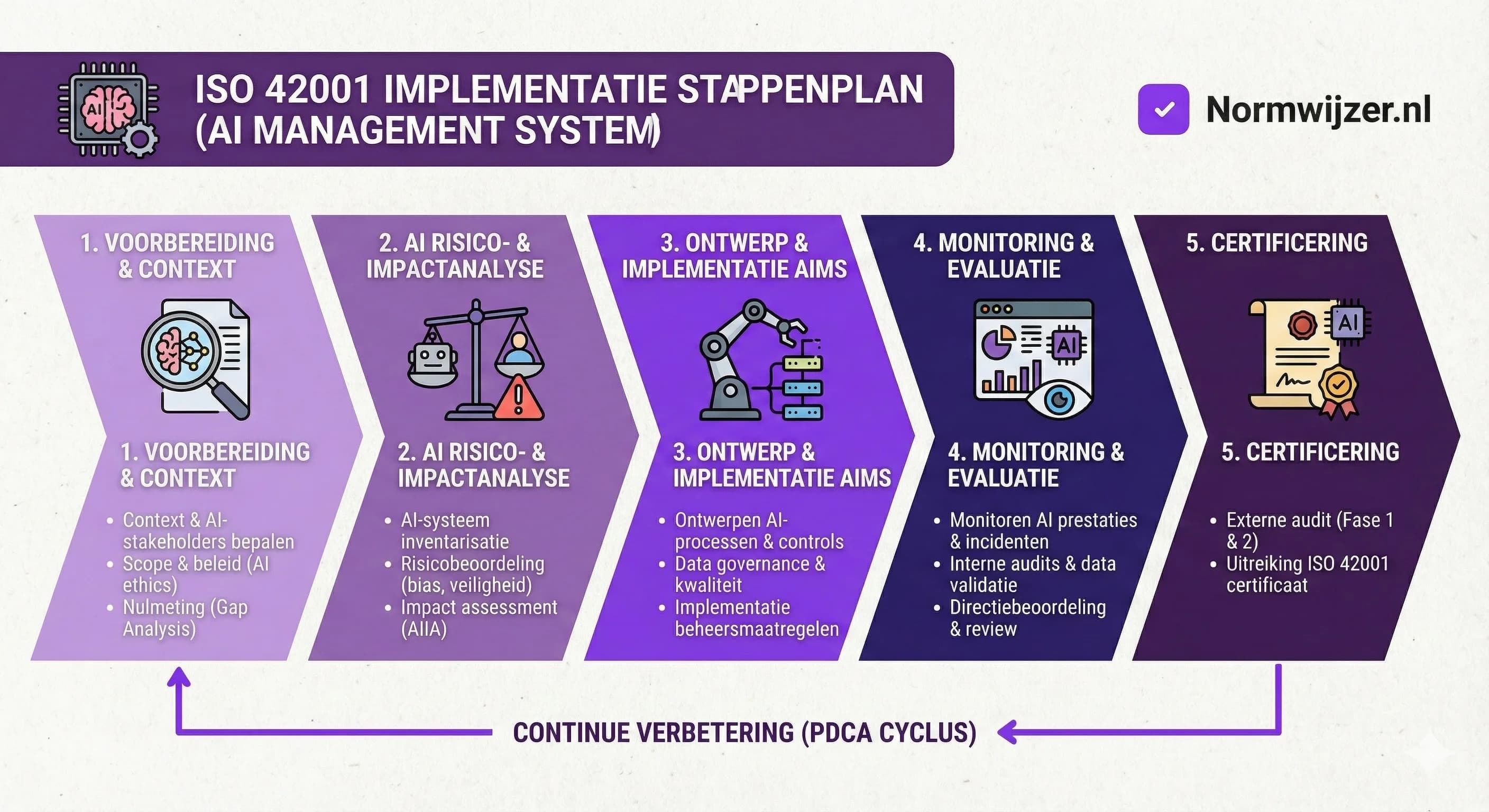
How do you get from nothing to an ISO 42001 certificate? This step-by-step plan gives you a practical route. ISO published the standard in December 2023, and in the Netherlands you can obtain it through NEN . Every organisation is different, but the basic steps are the same for everyone.
Before you start with ISO 42001
ISO 42001 certification requires preparation. You need:
Commitment from the board. Nothing will happen without support from the top. The board must understand what AI governance means and be willing to free up resources.
A person in charge. Someone has to lead the project. This does not have to be a full-time role, but someone must drive it forward.
An overview of your AI. You need to know which AI systems you have before you can manage them. That sounds obvious, but many organisations do not have a complete overview.
The route in seven steps
The journey from zero to certificate consists of 7 steps. The table below gives you an overview, from AI inventory to the certification audit. We elaborate on each step below.
| Step | What do you do? |
|---|---|
| 1. AI inventory | Map all AI systems in your organisation |
| 2. Gap analysis | Compare your current situation with the requirements of the standard |
| 3. Set up the management system | Set up policy, governance, processes and documentation |
| 4. Risk and impact assessment | Assess risks and societal impact per AI system |
| 5. Implement controls | Select and apply controls from Annex A |
| 6. Internal audit | Test your own system before the auditor arrives |
| 7. Certification audit | External audit in two stages (documentation and practice) |
We elaborate on each step below.
Tip: Start step 1 (AI inventory) with a broad view. Many organisations discover that they use more AI than they thought, for example purchased software with AI components. You need to include that in your management system too.
Step 1: AI inventory
Start with an inventory of all AI systems in your organisation. This is broader than you might think. You will find a detailed guide, including an example register table and an approach for shadow AI, on the page Inventorying AI systems.
What counts as AI? Not only ChatGPT or self-built machine learning models. Also recommendation algorithms, automated decision systems, predictive analytics, chatbots, image recognition and speech recognition.
Document per system:
- What does it do?
- Who is the owner?
- Which data does it use?
- Who are the users?
- Which decisions does it influence?
- Is it built in-house or purchased?
Many organisations discover during this step that they use more AI than they realised. Excel models with automatic forecasts, purchased software with AI components, cloud services with machine learning.
Step 2: Gap analysis
Now that you know which AI you have, you determine where you stand against the standard.
The gap analysis compares your current situation with the requirements of ISO 42001. For each clause and each control, you check: do we have this? Partly? Not at all?
This produces a list of gaps: the things you need to set up or improve. Prioritise based on risk and effort.
You can carry out the gap analysis yourself with the standard at hand, or you can hire a consultant. Certification bodies also offer gap analysis services.
Step 3: Set up the management system
Now you build the structure. The AI management system consists of:
Policy. An AI policy that describes the intentions and direction of the organisation. What are your principles for responsible AI?
Governance. Who is responsible for what? Roles, authorities, escalation paths.
Processes. How do you make decisions about AI? How do you assess new AI systems? How do you monitor existing systems?
Documentation. The standard requires certain documents. Policy, roles, risk analyses, Statement of Applicability. Read more about the required documentation. Start with a gap analysis to see which documents you already have.
This does not have to become a bureaucratic monster. Describe what you do in a way that suits your organisation. A start-up of 20 people needs different documentation from a bank with 10,000 employees.
Step 4: Risk and impact assessment
This is the heart of ISO 42001. For each AI system you carry out two analyses.
The risk analysis identifies what could go wrong. Technical risks (outages, errors), organisational risks (misuse, lack of knowledge), external risks (regulation, reputation). Read more about AI risk management.
The impact analysis looks at the consequences for people. What happens if the AI makes a wrong decision? Who is affected by it? How serious is that?
The impact analysis is unique to ISO 42001. You look not only at technical matters but at societal effects. Does your AI discriminate? Can people understand and challenge the decisions? Is someone’s privacy harmed?
Read more about the AI impact assessment.
Step 5: Implement controls
Based on your risk and impact analysis, you select controls from Annex A.
ISO 42001 has 38 controls divided over nine domains:
- AI policies
- Internal organisation
- Resources for AI systems
- AI system lifecycle
- Data for AI systems
- Information for interested parties
- Use of AI systems
- Third-party relationships
- Impact assessment
You do not have to implement all 38 controls. You choose what fits your risks. But you must be able to explain why you did not select certain controls.
Record this in the Statement of Applicability. For each control: applicable or not, and why.
Read more about the Annex A controls.
Step 6: Internal audit
Before you request the certification audit, you test your own system.
The internal audit checks whether you meet the requirements of the standard and your own policy. An internal auditor, or someone independent of the process being audited, assesses the documentation and the practice.
What do you typically find? Procedures that are not followed. Documentation that is out of date. Risks that have not been identified. Controls that do not work.
This is not a moment of failure but a learning opportunity. Every finding is a chance to improve before the external auditor arrives.
After the internal audit, you carry out corrective actions. You fix what is not right. Read more about internal audits.
Step 7: Certification audit
Now you are ready for the external audit. You request the certification audit from an accredited certification body.
The audit runs in two stages.
Stage 1 is a documentation review. The auditor assesses whether your management system is complete on paper. Are all required documents there? Is the policy coherent? Are the roles clear?
Stage 2 is the on-site audit. The auditor visits and checks whether you do what you have written down. Interviews with employees, review of evidence, observation of processes.
After stage 2 you receive a report with findings. If the result is sufficient, you receive the certificate. If there are shortcomings, you get time to correct them.
Read more about the audit process.
How long does ISO 42001 certification take?
The lead time depends heavily on your starting position and the complexity of your AI.
Fastest route (4-6 months): Small organisation, few AI systems, already experienced with management systems (ISO 27001, for example), dedicated team.
Average route (6-12 months): Medium-sized organisation, several AI systems, some experience with certification, part-time project team.
Complex route (12-18 months): Large organisation, many AI systems, no experience with management systems, limited resources.
Do not underestimate the time needed for a cultural change. ISO 42001 asks people to think differently about AI. Not only to build, but also to think about impact. That takes time.
Tips for a successful ISO 42001 implementation
Start small. You do not have to tackle all your AI systems at once. Start with the most important or highest-risk ones. Learn from that experience.
Involve the right people. AI governance is not an IT party. Involve legal, compliance, HR and the business as well. AI affects everyone.
Keep it concrete. Abstract policy rules are worthless if nobody knows what they mean. Give examples, make checklists, train people.
Use existing structures. Do you already have ISO 27001? Build on it. Do you have a privacy programme? Integrate with it. No duplicated work.
Plan for maintenance. Getting a certificate is step one. Keeping it requires ongoing attention. Plan annual reviews, audits and updates.
Need help?
You can carry out the process yourself or bring in help.
Doing it yourself is cheaper but requires more time and knowledge. Suitable if you have experience with management systems and the capacity to do it.
Hiring a consultant speeds up the process and brings in expertise. Costs vary; expect €500-1,500 per day.
A certification body can help with training and gap analysis, but not with implementation (because of its independence).
Read more about costs and lead times.
Next steps
- Look at the requirements of the standard in detail
- Read which documentation you need
- Understand AI risk management and the AI impact assessment
- Read how the internal audit and the certification audit work
- Choose a certification body
- Understand the relationship with the EU AI Act and determine via the high-risk AI classification which systems bring extra requirements
- Learn from the common mistakes
- Do not forget supplier management if you purchase AI
- If you are a start-up: ISO 42001 for start-ups
- Consider integration with existing systems
- Check the terms and definitions for an explanation of jargon