What is ISO 9001?
ISO 9001 is the international standard for quality management: a fixed set of requirements that shows organisations deliver what they promise and keep improving their work. The standard was developed by the International Organization for Standardization (ISO) . With a certificate, you prove to customers that an independent party has checked your processes.
The standard is recognised worldwide and can be applied to any organisation, regardless of size or sector. From a sole trader to a multinational, from a manufacturer to a healthcare institution. In the Netherlands, NEN is responsible for publishing the Dutch version. Want to get started right away? Follow the step-by-step plan to certification.
The official name is NEN-EN-ISO 9001:2015. NEN stands for the Dutch translation, EN for the European standard, and ISO for the international standard. In practice, everyone simply says “ISO 9001”.
ISO 9001 in brief
| Full name | NEN-EN-ISO 9001:2015 |
| Publisher | ISO (international), NEN (Dutch version) |
| Current version | ISO 9001:2015. A new version is planned for 2026, see current status |
| For whom? | Any organisation that wants to assure its quality |
| Mandatory? | Not by law, but often a contract requirement |
| Validity | 3 years, with annual surveillance audits |
| Costs | €3,000 - €15,000+ (depending on company size) |
| Lead time | 2-8 months |
Why would you want ISO 9001?
There are three main reasons why companies choose ISO 9001:
1. Your customers ask for it
Many large clients and governments require ISO 9001. Without a certificate, you are not eligible for the contract. In public tenders , you often see “ISO 9001 certificate required”.
An installation company that wants to take part in projects for housing associations soon finds out: without ISO 9001, you won’t even be invited to submit a quote.
2. You want to improve your processes
ISO 9001 forces you to look critically at how you work. What exactly do you do? Who is responsible for what? Where does things sometimes go wrong? By recording and measuring this, you discover where you can improve.
Many companies say afterwards: “We should have done this much earlier.” Not because of the certificate, but because of the insights it brings.
3. You want to stand out
An ISO 9001 certificate is a quality mark. It shows potential customers that an independent party has checked whether you deliver quality. Certification bodies such as Kiwa , TÜV and DEKRA carry out these audits. That builds trust, especially with new customers who don’t know you yet. You can read how to check such a certificate in checking the ISO quality mark and certificate.
What is a quality management system?
A quality management system (QMS) is simply the way your organisation ensures its quality. It consists of:
- Processes: how you carry out your work
- Procedures: the agreements about who does what
- Records: the evidence that you do what you say
That doesn’t have to be a thick manual. Since the 2015 version, ISO 9001 has become more flexible. You describe how you do things, not how a standard says they should be done.
Many companies still think they need an extensive quality manual. That hasn’t been the case since 2015. The standard asks for “documented information”, but you decide how to record it. A flowchart can be enough. Read more about the quality manual for ISO 9001.
The 7 principles of ISO 9001
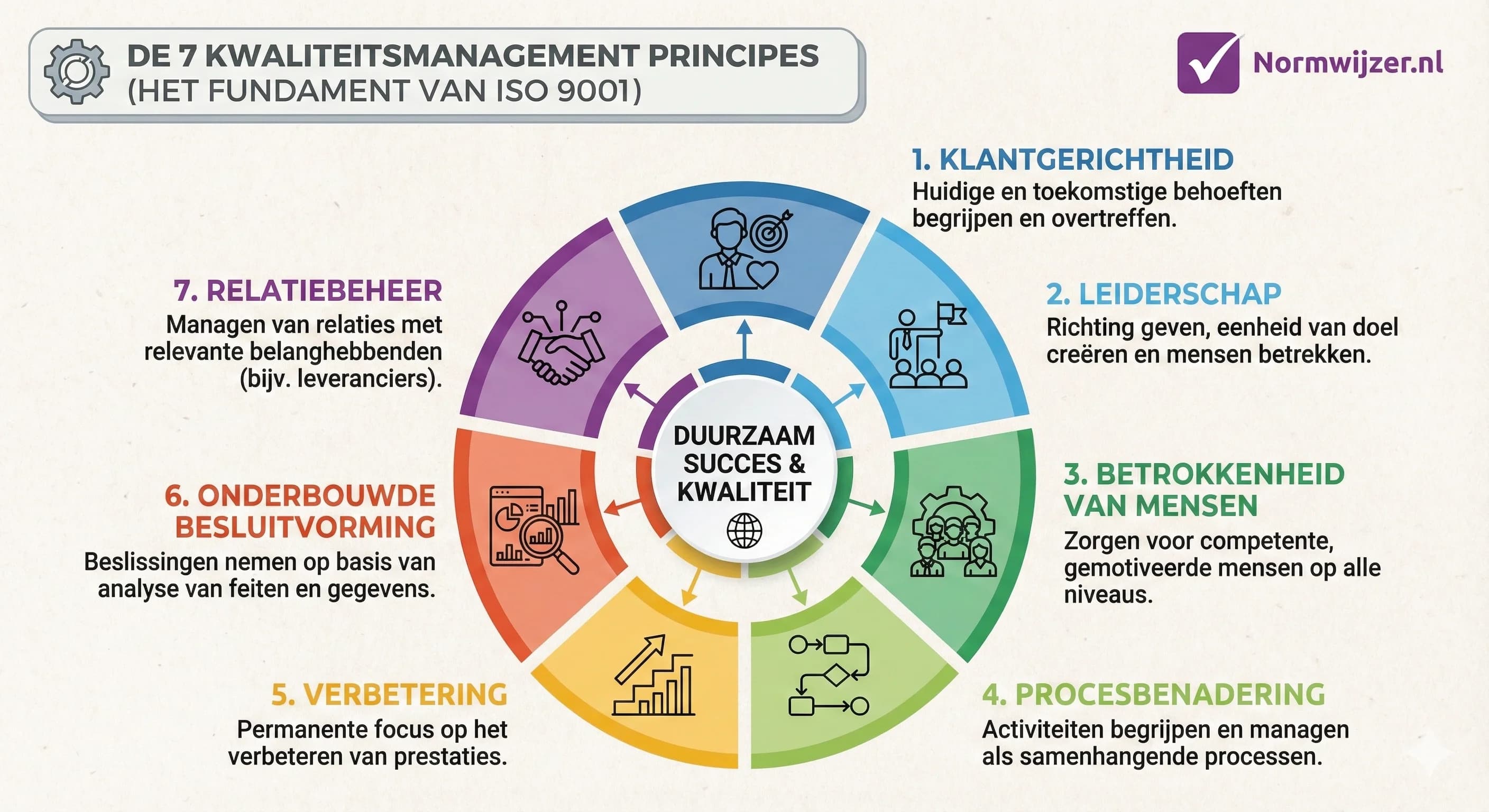
ISO 9001 is built on seven principles . You don’t need to know them by heart, but they help you understand what the standard is about:
- Customer focus - Everything revolves around meeting customer expectations
- Leadership - Management must take the lead and set a good example
- Engagement of people - Quality is everyone’s business, not just the quality manager’s
- Process approach - You view your work as a connected whole of processes
- Improvement - You keep looking for ways to get better
- Evidence-based decision making - You measure and analyse before you make decisions
- Relationship management - You maintain good relationships with suppliers and other interested parties
The PDCA cycle in ISO 9001
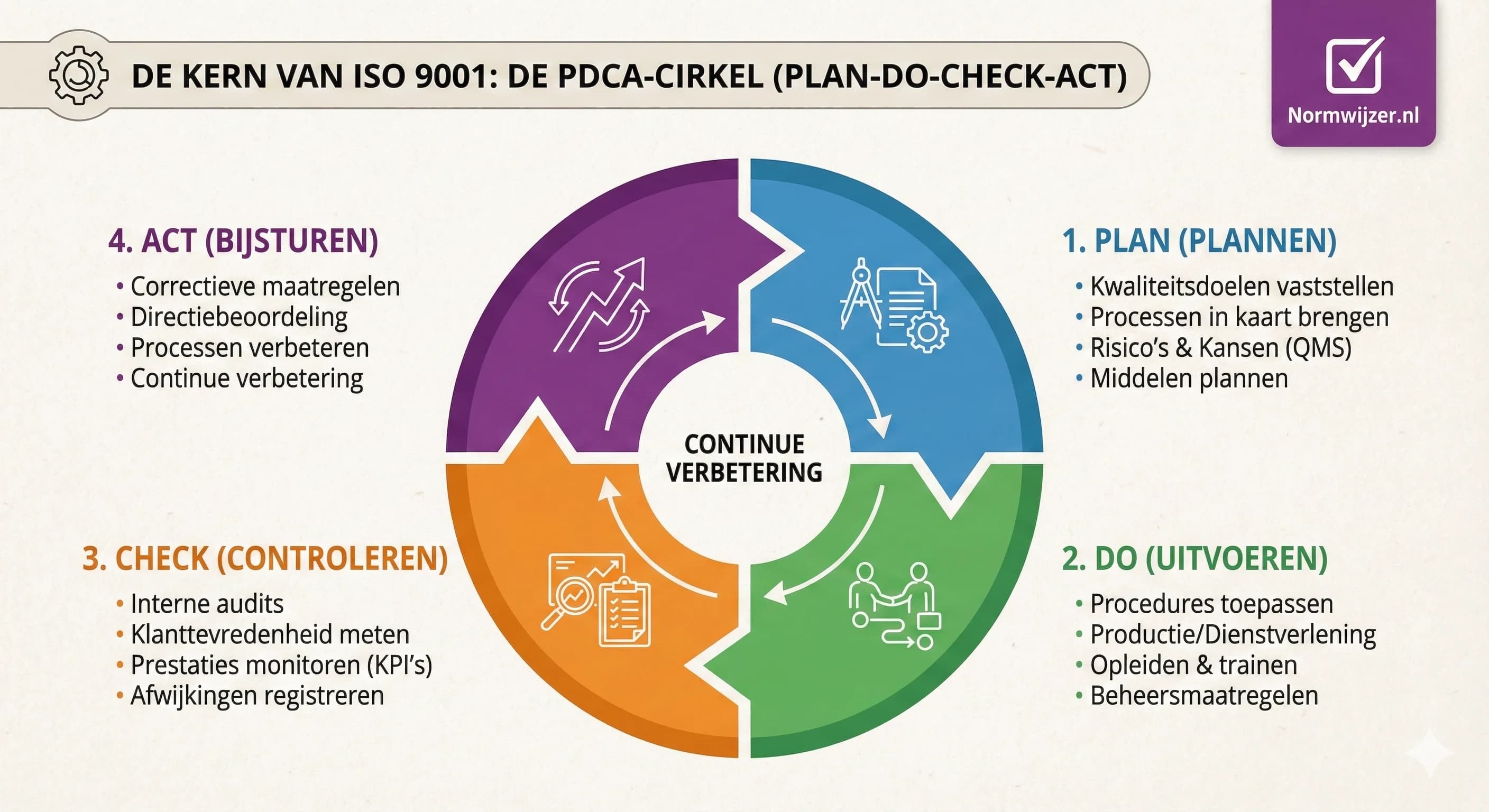
ISO 9001 revolves around the Plan-Do-Check-Act cycle. This is a simple but powerful way of working:
- Plan: Decide what you want to achieve and how
- Do: Carry out your plan
- Check: Measure whether it works as intended
- Act: Adjust where needed and improve
You apply this cycle to everything, from your whole organisation to individual processes. It makes sure you don’t stand still but keep improving continuously.
Is ISO 9001 mandatory?
No, ISO 9001 is not legally required. No Dutch law makes the certificate compulsory. In practice, it is often required, for example in public tenders by the government , as a requirement from large clients, or in sectors where customers expect it.
When it is effectively needed, which alternatives you have, and what to do when a client asks for it? You can read that on the page is ISO 9001 mandatory?.
Tip: if you expect that ISO 9001 will be needed at some point, start sooner rather than later. A certification process takes time, and you don’t want to set up a system under pressure.
How much does ISO 9001 cost?
Costs depend on your company size and complexity:
| Company size | Indicative total costs |
|---|---|
| Sole trader / small (1-10) | €3,000 - €6,000 |
| SME (10-50) | €6,000 - €12,000 |
| Larger (50-100) | €12,000 - €20,000 |
| Large (100+) | €20,000+ |
These are the costs for the first year, including guidance and the certification audit. Read more on the costs and timeline page.
How long does ISO 9001 certification take?
This also depends on your starting point:
- If you already have a lot in order: 2-4 months
- Average SME: 4-6 months
- Complex organisation or starting from scratch: 6-12 months
It isn’t only about documentation. You also need to show that your system works. That means you have to apply it for a while before the auditor visits.
Certification isn’t the end. Read how to keep your system running on the page about maintaining your ISO 9001 system. Do you work in a specific sector? Then see our pages on ISO 9001 for construction, ISO 9001 for IT companies, ISO 9001 for healthcare institutions and ISO 9001 for transport and logistics.